A large-format professional 3D printer represents a significant investment for a company looking to integrate additive manufacturing into their production, prototyping, or product development processes. Before purchasing this equipment, it’s essential to carefully analyze its specifications to determine whether it will meet your business needs.
A large-format printer shouldn’t be evaluated solely by the maximum part size it can produce. Precision, compatible materials, productivity, stability, ease of use, maintenance, and operating costs also need to be considered .
Choosing the right printer means finding a balance between technical specifications and the actual applications the machine will be used for. A well-sized solution can significantly improve production capacity, while a choice based solely on print volume can lead to unnecessary costs.
First, define your production needs
Before analyzing the features of a large professional 3D printer, it is important to define the type of parts you want to produce.
A company specializing in prototyping may have different needs than a company looking to produce tools, functional components, or small series.
For this reason, it is worth analyzing:
- Typical part dimensions.
- Materials that will be used.
- Precision required.
- Quantity of components to be produced.
- Frequency of use.
- Time available for each production phase.
- Required mechanical characteristics.
- Post-printing operations.
This information allows you to identify which features are truly important and avoid investing in features that won’t be needed.
Print volume
The volume of construction work is probably one of the first aspects to evaluate.
A large-format 3D printer can produce significantly larger components than conventional equipment. However, it’s advisable to choose the print volume based on the actual parts you need to produce. Too little capacity can force you to constantly sort the components. Too much capacity can unnecessarily increase investment and operating costs.
It is also important to check the actual usable dimensions of the production area and not just the maximum values indicated for the equipment.
One-piece production
One of the main reasons for choosing a large format printer is the ability to produce certain components in one piece.
This can reduce the number of joints and reduce some assembly operations. For large prototypes and functional components, this capability can facilitate design validation and improve geometric continuity.
However, it’s important to consider whether producing the entire component in a single piece is always the most efficient solution. In some cases, modular production can offer significant advantages.
Modular production
When the size of the object exceeds the production volume or when you want to facilitate transportation, it may be convenient to divide the piece into different modules.
Modular manufacturing allows you to design each section so that it can be printed independently and assembled later. This strategy can also facilitate modifications. If one section changes, it may be sufficient to reproduce just that module.
Before purchasing a large-scale 3D printer, it is therefore advisable to analyze both its ability to produce complete parts and the possibilities for working with modular designs.
Dimensional accuracy
Precision is a key factor when using a printer to produce technical components.
In large components, even small deviations can be significant, especially when there are elements that need to be assembled together.
Accuracy depends on several factors, including:
- Rigidity of the structure.
- Quality of movement systems.
- Thermal control.
- Extrusion system.
- Production parameters.
- Material characteristics.
It’s not enough to consider theoretical resolution. It’s equally important to evaluate the actual accuracy and repeatability the machine can offer.
Process repeatability
A company needs consistent results. Repeatability allows the production of multiple units of a component while maintaining similar characteristics.
This is especially important for small runs and functional components. A machine that produces excellent results in a single print but exhibits large variations between jobs may not be suitable for a professional environment.
For this reason, repeatability should be considered alongside overall accuracy and reliability.
Compatible materials
Another crucial factor to consider before purchasing a large-format professional 3D printer is its compatibility with the materials the company intends to use.
Not all machines are able to function properly with the same materials.
Depending on the configuration and technology, different thermoplastic materials can be used, including:
- PLA.
- ABS.
- PETG.
- Polycarbonate.
- Polyamides.
- Fiber-reinforced materials.
- Composite materials .
If the company plans to use technical materials, it is essential to ensure that the machine is set up to process them correctly.
Fiber-reinforced materials
Materials reinforced with carbon fiber or other fibers may be attractive for certain components that require a combination of stiffness, strength, and lightness. However, these materials can be more demanding during the printing process. They may require suitable extrusion systems and specific parameters.
Therefore, before purchasing a machine it is important to check not only whether it accepts a certain material, but also under what conditions it can work with it.
Extrusion system
The extrusion system plays a fundamental role in printers that work by material deposition. In a professional machine, extrusion stability directly affects layer quality and component consistency. When using technical or reinforced materials, the choice of extrusion system becomes even more important.
It is necessary to check its compatibility with the intended materials and its ability to maintain stable conditions during prolonged printing.
Temperature control
When manufacturing large components, thermal management can have a significant impact on the final result.
Thermoplastic materials can shrink during cooling. Temperature differences in a large component can increase the risk of warping. Therefore, before purchasing a large-format 3D printer, it’s important to evaluate its thermal control systems and available production conditions.
Increased thermal stability can help improve dimensional quality and repeatability.
Print speed
Production speed is another aspect that needs to be considered.
A large-format machine can take many hours to produce a single part. Therefore, even small differences in print times can significantly impact productivity. However, it’s not advisable to choose a printer based solely on its maximum speed. Actual productivity also depends on process stability, setup times, material consumption, success rate, and subsequent operations.
The goal should be to find a balance between speed and quality.
Effective productivity
Productivity is not measured solely by the number of millimeters of material deposited per second.
For a company, it is more useful to analyze how many correct pieces the machine can produce in a given period.
It is also necessary to take into account the time required for the following activities:
- Prepare the file.
- Set up printing.
- Load the material.
- Remove the component.
- Remove the supports.
- Carry out finishing work.
- Prepare the next task.
Analyzing the entire flow allows us to understand the actual productivity of the system .
Surface quality
While 3D printing is primarily used for industrial applications, surface quality can be important. A prototype intended for presentation may require a specific aesthetic finish. A functional component may require specific surfaces in contact or assembly areas. Quality depends on the technology, layer height, material, orientation, and printing parameters.
Therefore, it is important to define the level of finishing required by the company before purchasing the machine.
Ease of use
A professional printer must be technically advanced, but it must also allow for easy process management. Ease of use can have a direct impact on productivity. A complex system can increase setup times and require more operator training. It’s recommended to evaluate the control interface, job preparation, and ease of parameter modification.
A clear workflow helps reduce errors and allows different operators to work consistently.
Preparing the software and files
Preparation software is an essential part of the production process.
The company must be able to import CAD models, define orientation, manage supports, and configure parameters such as layer height, speed, and infill. It can also be helpful to have options to optimize material consumption and adapt the process to different types of components.
A good software environment facilitates the connection between digital design and physical production.
Automation
In certain industrial contexts, automation can be an important factor.
Process monitoring, task management, and some repetitive operations can be automated to reduce manual intervention.
Not all companies need the same level of automation, but it’s a good idea to consider whether your chosen solution can be integrated into a more automated workflow in the future.
Reliability and long-lasting operation
Printing large parts can take many hours. For this reason, machine reliability is crucial.
An interruption during a prolonged production process can result in significant loss of time and materials. Before purchasing, it’s advisable to evaluate the machine’s stability, the quality of its components, and its ability to maintain consistent conditions during long work sessions.
Reliability should be considered a factor directly related to productivity and cost per part .
Maintenance
Preventive maintenance should be an integral part of the assessment.
A printer used regularly requires periodic maintenance, cleaning, and replacement of certain components. It’s important to know which tasks can be performed in-house and which require specialized assistance.
An easy-to-maintain machine can reduce downtime and allow for more intensive use.
Material consumption and efficiency
The amount of material used has a direct influence on the production cost.
Material efficiency can be improved through various strategies, such as optimizing thickness, reducing substrates, and using appropriate internal structures. Before purchasing a printer, it’s advisable to analyze not only the materials it can use, but also how to optimize their consumption.
When manufacturing large components, even small improvements can translate into significant savings.
Total cost of ownership
The purchase price is not the only cost to analyze.
To properly evaluate an investment, it is important to consider the total cost of ownership, which may include:
- Starting price.
- Materials.
- Energy consumption.
- Maintenance.
- Replacement components.
- Work.
- Machine operating time.
- Subsequent operations.
- Cost of failed prints.
A cheaper car at the time of purchase is not necessarily the most cost-effective alternative in the long run.
3D solutions for printing and large format
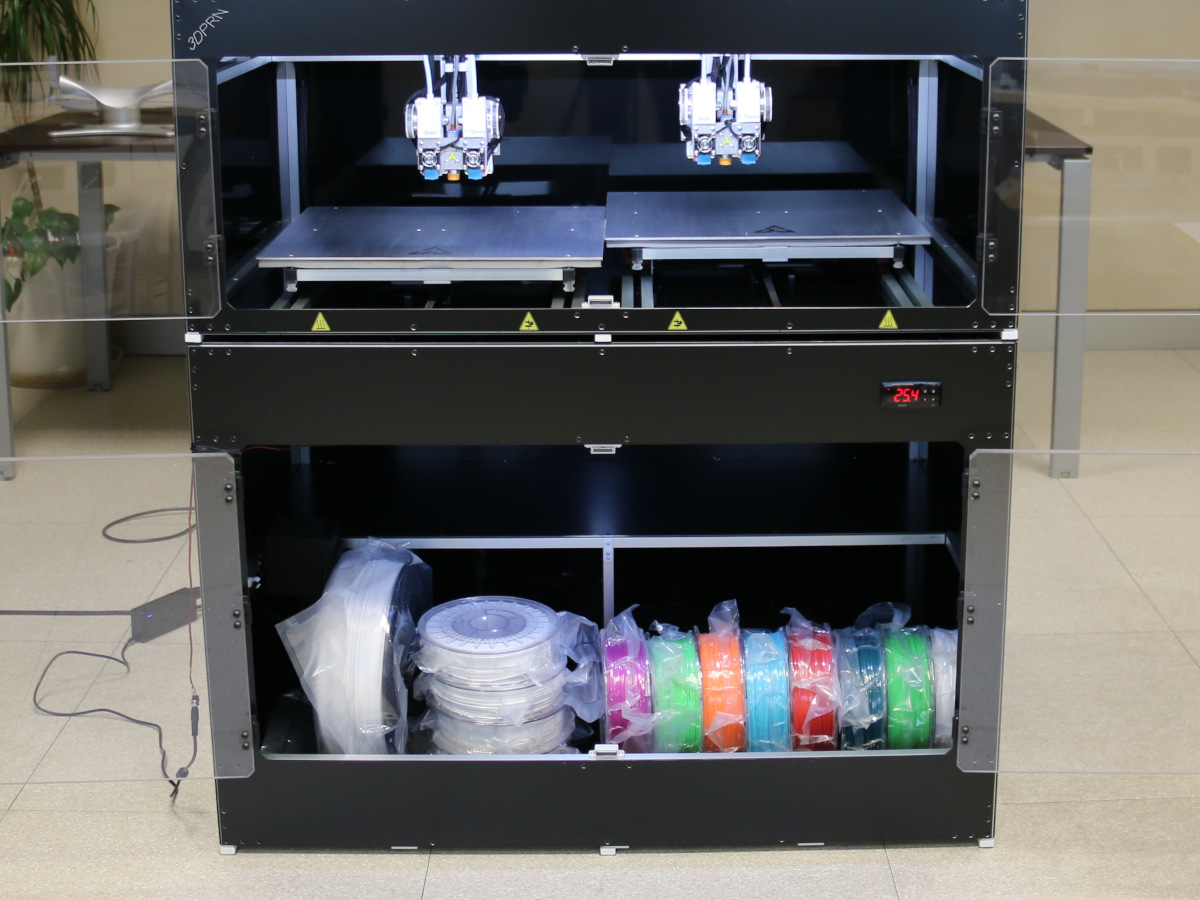
In the field of professional large-format 3D printing , 3DPRN is associated with solutions oriented towards large-format additive manufacturing.
Before purchasing a machine, it is important to analyze its characteristics in relation to the company’s actual needs.
Print volume, compatible materials, accuracy, productivity and reliability must be evaluated together.
The most suitable solution will be the one that allows the development of the planned applications with a reasonable balance between capacity, performance and cost.
Technical assistance and support
Another aspect to consider before purchasing is technical assistance .
A company using a professional 3D printer must have solutions for potential problems related to setup, maintenance, or operation. The availability of technical support and documentation can facilitate commissioning and reduce downtime.
It is also advisable to evaluate the training required for operators to use the equipment correctly.
Thinking about future applications
Buying a large professional 3D printer should be considered a medium to long-term investment.
A company’s needs can evolve. Today, it might primarily require prototypes, while in the future, it might want to produce tools, functional components, or small production runs. For this reason, it’s advisable to choose a solution that offers flexibility in terms of materials and applications .
An adaptable machine can offer greater value as a company’s experience in additive manufacturing increases.
Pre-purchase checklist
Before making a decision, it is useful to check that the chosen solution meets the main requirements:
- Adequate print volume .
- Materials compatible with the intended applications.
- Sufficient accuracy and repeatability.
- Speed appropriate to the production level.
- Good thermal stability.
- Appropriate extrusion system.
- Efficient preparation software.
- Easy maintenance.
- Reliability during prolonged printing.
- Total cost compatible with the production budget.
- Possibility to expand applications in the future.
This analysis allows for a more objective comparison between the different alternatives.
Before purchasing a large-format professional 3D printer , it’s crucial to consider much more than just the maximum print volume. The print volume must be matched by an appropriate combination of accuracy, repeatability, materials, productivity, reliability, and ease of use .
It is also important to evaluate the extrusion system, thermal management, software, maintenance and costs associated with day-to-day use.
For large components, it may be interesting to be able to produce them in a single piece, while modular production allows us to handle components that exceed the available volume.
The choice of materials must also be adapted to the specific needs of each application, from thermoplastics intended for prototypes to technical and reinforced materials for functional components.
Finally, the initial price should be analyzed in conjunction with the total cost of ownership , productivity, and reliability of the equipment.
A well-considered choice allows for more efficient integration of large-format 3D printing into business processes, leveraging its benefits for prototyping, custom manufacturing, mold making, and small production runs. In an industrial context, the best printer isn’t necessarily the largest or fastest, but rather the one that offers the right balance of performance, quality, productivity, and actual production needs .